


How Technology Improves Traffic in Greater Estero
Key Take-Aways
- Lee County is using advanced traffic management technology to improve congestion in the greater Estero area. The County's Centracs Advanced Transportation Management System (ATMS), Traffic Responsive Programming (TRP), and expanding network of fiber-connected traffic signals, sensors, and traffic readers help optimize signal timing based on real-time traffic conditions.
- Adaptive traffic signal technology is expected to play a major role in easing future congestion. Lee County is evaluating and expanding Edaptive signal control technology, which uses real-time traffic data to automatically adjust cycle lengths, green times, and signal coordination to improve traffic flow without widening roads.
- Wrong-Way Vehicle Detection Systems are improving roadway safety. FDOT's radar- and sensor-based system alerts wrong-way drivers and law enforcement immediately, with more than 80% of drivers correcting their mistake before a crash occurs.
- Traffic signal timing in Estero is dynamic—not fixed. Signal coordination along Corkscrew Road and Ben Hill Griffin Parkway adjusts continuously based on traffic volumes, school schedules, pedestrian crossings, and special events, although heavy pedestrian activity can temporarily disrupt synchronization.
- Emergency vehicle signal pre-emption is becoming more sophisticated. Lee County is developing a next-generation system that will integrate traffic signals with emergency dispatch routes, allowing fire, EMS, and law enforcement vehicles to receive coordinated green lights while minimizing disruptions to other traffic.
- Modern traffic infrastructure requires significant investment. New traffic signals cost approximately $1.2–$1.5 million, with much of the expense dedicated to cameras, vehicle detection, communications, and software needed to support advanced traffic management technologies.
- Transportation remains the top concern for Estero-area residents. With major road expansion projects years away, Lee County is relying on intelligent transportation systems, AI-assisted traffic analysis, and adaptive signal technology as the most immediate tools to improve mobility and reduce congestion.
Published July 9, 2026 by Engage Estero
Written by

Mark Novitski
Consultant to Engage Estero
East Corkscrew Alliance Chair
Transportation in the greater Estero Area has been and will be a major concern and challenge.
Every community survey identified transportation issues as the top concern among residents. Previously, leaders from Engage Estero and the East Corkscrew Alliance had the opportunity to visit and receive a briefing at the Lee County Department of Transportation (LC DOT) Traffic Operations Center. Since our visit, the LC DOT Traffic Operations Center has moved into the Lee County Emergency Operations Center. The tour and briefing were excellent and helped us “non-engineers” understand the transportation efforts and challenges in traffic management.
The Florida Department of Transportation (FDOT) has been installing and linking Florida’s Wrong-Way Vehicle Detection Systems (WWVDS). WWVDS uses radar and sensors on exit ramps to detect wrong-way drivers. The system immediately activates flashing LED signs for the driver and sends alerts to law enforcement and overhead message boards for other motorists. The systems have proven highly effective, with over 80% of drivers self-correcting and turning around.
LC DOT is continually working to improve traveling throughout Lee County with upgrades and enhancements. This includes installing microwave traffic readers on County Roads, installing/upgrading fiber-connected traffic signals, upgrading traffic control software, and continually monitoring, recording, and analyzing data to inform improvements.
During the June 2026 meeting of the Citizens Advisory Committee (CAC), a committee of the Lee County Metropolitan Planning Organization (MPO), the CAC was briefed on the Lee County DOT Centracs Advanced Transportation Management System (ATMS) and the implementation status of the new advanced emergency vehicle pre-emption system.
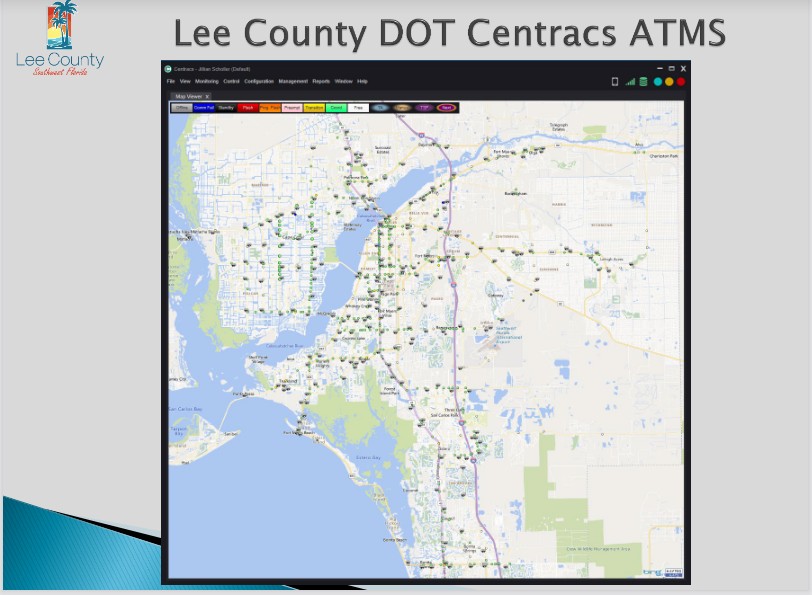
How is Estero Traffic Controlled? Q&A
Jillian Scholler, PE, Deputy Director, Lee County Department of Transportation, provided answers to our questions about Lee County DOT and traffic signal operation.
Q1. At one time, I remember the four traffic signals around Corkscrew Road and Ben Hill Griffin Parkway were synchronized. It does not appear to me or others that they are now synchronized.
A. The signals are still coordinated. However, there is significant pedestrian activity throughout the day, which can disrupt coordination among the signals.
Q2. How is the signal at Corkscrew Road and Stoneybrook Golf Drive coordinated?
A. The signal is coordinated eastbound and westbound with Corkscrew Road and Ben Hill Griffin Parkway during the morning and afternoon peak periods, including school times, when traffic demand on the side street is significant.
Q3. How does the signal at Corkscrew Road and Miromar Outlets Boulevard operate?
A. This signal allows only eastbound left turns and southbound right turns, and it operates on a half-cycle across all timing plans. This means that for every cycle at Ben Hill Griffin Parkway, the Miromar Outlets Boulevard side street is served twice.
Q4. How are the signals at Ben Hill Griffin Parkway and Grand Oaks Drive coordinated?
A. The signals for northbound traffic are coordinated with the heavy eastbound left-turn movement from Corkscrew Road onto northbound Ben Hill Griffin Parkway.
Q5. How often is traffic signal timing adjusted for seasonal traffic, school schedules, or other changing conditions?
A. The Corkscrew Road traffic signal system operates Traffic Responsive Programming (TRP) 24 hours a day, seven days a week. The system automatically adjusts timing plans and cycle lengths based on real-time traffic volumes and directional traffic patterns. The timing plans are typically field-checked annually. Signal cycle lengths range from 110 to 170 seconds, with some signals operating on half-cycles during the 150- and 170-second timing plans.
Q6. Does the Traffic Operations Center have the ability to adjust signal timing in real time during backups or special events?
A. Yes. Staff monitor the traffic signal system Monday through Friday from 6:00 a.m. to 7:00 p.m. In most cases, Traffic Responsive Programming can manage changing traffic conditions automatically. However, special timing adjustments have been implemented for events such as the post-game traffic surge at Everblades games. For anticipated major events, staff can remotely monitor the system and make real-time timing adjustments as needed.
Q7. How long does it take for the traffic signal system to recover after law enforcement manually controls an intersection, such as at Hertz Arena?
A. The traffic signal system typically returns to normal coordinated operation within one or two signal cycles.
Q8. When a pedestrian pushes a crosswalk button, how long does it take for the signals to return to their programmed coordination?
A. Pedestrian crossings on the main roadway temporarily interrupt signal coordination. It generally takes approximately two to three signal cycles for the system to return to coordinated operation.
Q9. I understand that police, fire, and EMS vehicles will eventually be able to receive green lights through intersections. How does the current and future emergency vehicle pre-emption system work?
A. Currently, the Iona McGregor and South Trail Fire Districts use a GPS-based signal pre-emption system. GPS devices on emergency vehicles communicate directly with traffic signal controllers, providing a green light in the vehicle's direction of travel when it approaches an intersection.
Lee County is also developing a more advanced emergency vehicle pre-emption system that will connect the Central Signal System with the Public Safety Dispatch System and the Lee County Sheriff's Office dispatch system. This enhanced system will use emergency response routes established by dispatch to make targeted adjustments to traffic signals, providing green lights where needed while minimizing disruption to overall traffic flow.
Q10. Are Lee County's traffic signal systems using artificial intelligence, and are there plans to expand AI in the future?
A. Depending on how artificial intelligence is defined, Traffic Responsive Programming (TRP) can be considered a form of AI because it collects traffic volume data every 15 minutes and uses algorithms to select the most appropriate timing plan based on traffic volumes and directional travel patterns.
What is Edaptive Technology and how does it Help Traffic?
The next level of intelligent traffic management is Edaptive technology. Unlike TRP, the Edaptive system continuously evaluates traffic volumes to adjust cycle lengths and green times for individual traffic movements. It requires extensive lane-by-lane traffic data collected between and at each signalized intersection. Lee County currently operates an Edaptive system along Cypress Lake Drive. In addition, the County has deployed AI-enabled video and LiDAR detection systems that analyze traffic conditions to improve vehicle detection and enhance roadway safety.
Realizing that expanding our roads in the greater Estero area is years “literally ‘Down the Road,’” AI and technology are the help we can see in the near future. I have to believe LC DOT is looking and planning to implement traffic Adaptive on other roads throughout the County.
Like our home technology, where we have the choice of computer software and hardware (this article was written on an HP Laptop), there are multiple technologies for traffic control.
What is Adaptive Signal Control Technology?
Another technology that was researched is Adaptive Signal Control Technology (ASCT). This technology is used in other Florida counties and cities. Edaptive Signal Control Technology (ASCT) uses real-time sensor data, vehicle detectors, video cameras, and probe vehicle GPS to continuously adjust traffic signal timing (cycle length, green-time splits, and offsets) to match actual demand, second by second. ASCT responds dynamically to what is on the road at any given moment.
The Edaptive system LC DOT currently has is an upgrade from the Adaptive system that was in this corridor. The main difference is that the Adaptive system could change the green times, splits, and offsets but not the cycle length. The Edaptive system can change the cycle length at all times.
Like any solution, there is a cost to implement new software and systems. LC DOT is working to enable new traffic signals with technology (vehicle detectors, cameras, and traffic counters) to support future upgrades and enhancements.
Besides purchasing the right-of-way acquisition for traffic signals, much of the cost of a new traffic signal ($1.2 - $1.5M) is in electronic monitoring technology (hardware and software). Upgrading older traffic signals to support the information gathering technology is also expensive.
How to Stay Up to Date on Lee County DOT?
- To stay up to date on Lee County transportation efforts, follow the MPO and its committees at https://leempo.com/.
- To keep up with Lee County DOT projects, check the weekly Roadwatch Update, posted every Thursday at www.leegov.com/dot/roadwatchupdate.
- Sign up for updates from Lee County Government at www.leegov.com/resources/newsletters, and
- Follow on social media at www.leegov.com/socialmedia .
Related Articles
Dangerous U-Turns by Large Commercial Trucks on Corkscrew Road in Estero
October 17, 2026

Village of Estero Supports Resident Concerns Over I-75 Expansion Impacts
September 15, 2026

I-75 Expansion Must Not Come at the Expense of Estero’s Quality of Life
September 11, 2026

Be Informed,
Get Engaged,
and Make an Impact!

At Engage Estero, we believe in the power of community. As a nonpartisan, nonpolitical, nonprofit, we conduct evidence-based research to provide unbiased information about local issues, helping you improve your quality of life.