Introduction:
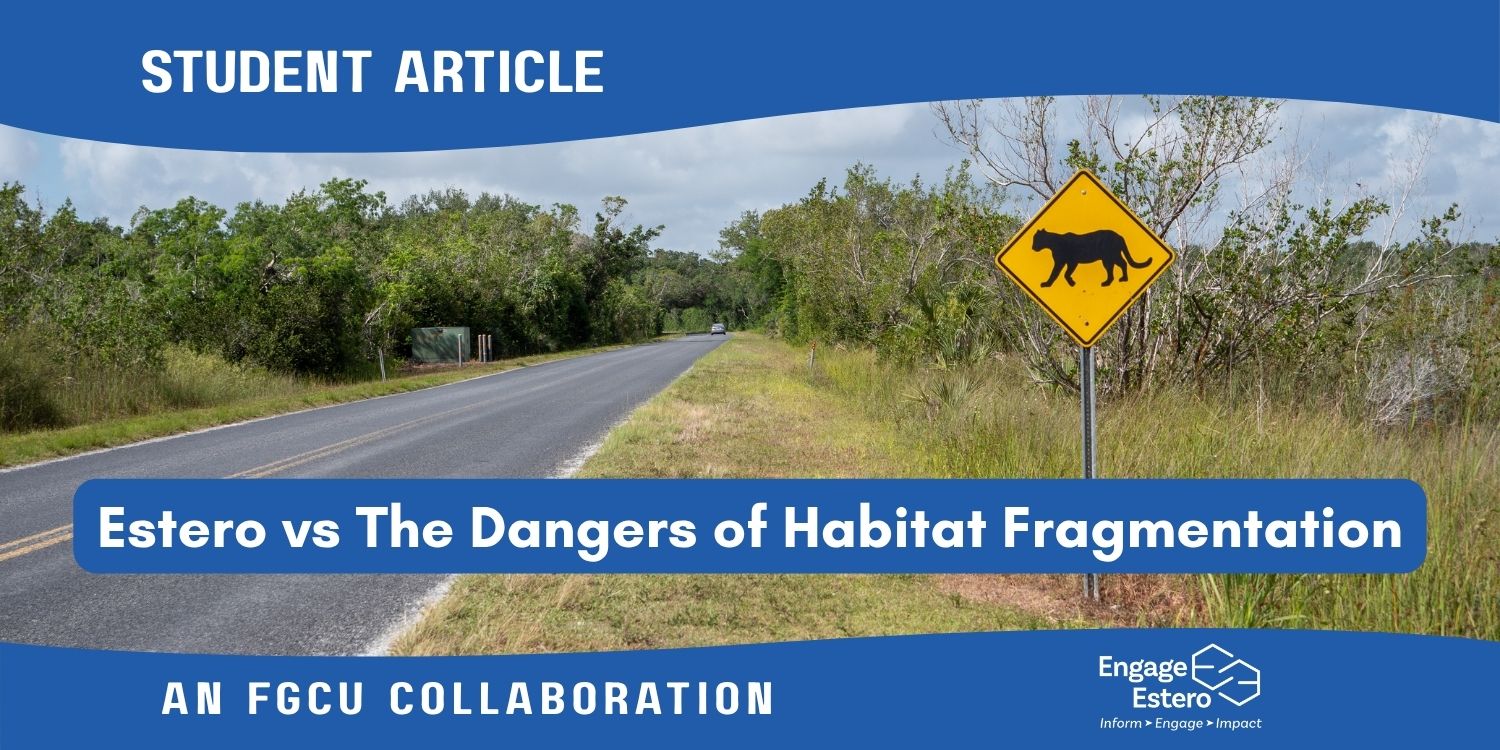
Estero is home to many conservation parks that serve to protect wildlife habitats, including marine life, and native ecosystems. A lot of history is preserved at those sites and as they have become very popular for tourists to visit and soak in what the Gulf Coast of Florida has to offer. The importance of having conservation parks is not about the beauty they hold, but rather the big environmental keystone that they are. Habitat fragmentation is the process of habitats being divided into isolated, more uninhabitable areas. Humans are the main culprit of this and the stakes are high. To mitigate the risks and long-lasting negative effects to Estero’s environment, better urban planning, state policies, and community support should be put in place. The more consistent we are with these solutions, the faster positive progress will come.
Background and What Changed:
Estero is the Spanish word for estuary, where the river meets the sea. Around the 1800’s, Estero was mostly farms, pure nature, and barely any roads were built. Of course, humble cities become modernized as time goes on. In the early 2000s, rapid population growth changed everything.
Authorities approved lots of new housing projects, which led to the need for better transportation. To handle the traffic the road was widened, and East Corkscrew Road went from a minor road to a main road of travel. This development is how Estero ended up with the division of natural habitats.
Habitat Fragmentation happens mostly when roads, buildings, and malls are being built. Animals lose their homes, and it gets harder for them to find nutrient resources and a secure community. It also increases the rate of road kills, which already is an everyday occurrence throughout Florida due to wildlife being exposed to roads, cities, etc. Species in Estero, and along East Corkscrew Road, deal with all these issues.
Evidence and Stakes:
Habitat loss is Florida’s most significant challenge to its biodiversity in the past century. Human population is a threat to habitats due to the strong relationship with urban development. If the population doubles in the next five decades, it is predicted that 7 million acres of agricultural lands will be claimed by subdivisions, roads, shopping centers, etc. (FWC, 2022). Evidently, Florida is one of the states with the most risk for loss of biodiversity and wetlands due to urban expansion. Florida lists 117 animals and 413 plants as endangered or threatened (Conservation Biology, 2008). Invasive species are an extra threat when they mix with native species, and drive them out of their habitat after it has been fragmented into smaller divisions.
What Could be Done Next?
Fortunately, there are many solutions to reduce habitat fragmentation starting with mitigation to reduce damage. The solutions must balance both nature conservation and further development in Estero.
First, one solution would be prioritizing time and money into wildlife crossings, which are already effective in different places in Florida. They are bridges or tunnels built for animals to go over/under existing roads. This would easily allow animals to cross safely and move around freely again. Some Florida native mammals who would benefit from this would be the Florida panther or raccoons who are a common roadkill species. The benefits would be reducing collisions and reconnecting habitats. Instead of putting so much effort into planning new homes and city developments, local governments can become educated about deforestation and pollution because of it.
Citizens of Estero can make changes by becoming involved in local organizations specializing in Florida’s ecosystem preservation. Locals can protest laws to get the attention of policy makers as well; anything that will push the importance of saving Estero’s habitats.
Another idea is to respect nature and work around green areas that are less populated with native species. This is a more balanced approach to just destroying land. However, it might not work because developers prioritize profit. That is exactly why the people of Estero have the power to help their community. Keep Lee County Beautiful and Conservancy of Southwest Florida offer active volunteer work who plan to restore beaches, rivers, and other negatively affected environments. Lastly, donations are important to support development of protection techniques such as camera systems to monitor wildlife populations and illegal activities.
Conclusion
Urbanization and other plans brought up by local governments are the main causes of habitat fragmentation. The community of Estero can push for strong solutions which are volunteer work, donations to organizations specific to habitat conservation, and voting for laws for urban planning that works around rich ecosystems.
References
U.S. Department of Agriculture. (n.d.). Reduce landscape fragmentation. https://www.climatehubs.usda.gov/approach/reduce-landscape-fragmentation
Lee County Government. (n.d.). Corksckrew Road Widening Project. https://www.leegov.com/corkscrew
Keep Lee County Beautiful https://volunteer.unitedwaylee.org/agency/detail/?agency_id=129018
Conservancy of Southwest Florida https://conservancy.org/
Strategic Habitats for Biodiversity Conservation in Florida https://conbio.onlinelibrary.wiley.com/doi/abs/10.1111/j.1523-1739.2001.98355.x Habitat Loss, Fragmentation, and Degradation from Climate Adaptation Explorer https://climateadaptationexplorer.org/impacts/existing-stressors/habitat-loss
Wildlife 2060- Habitat Loss https://myfwc.com/conservation/special-initiatives/wildlife-2060/loss/
Estero History https://estero-fl.gov/estero-history/
Related Articles by Engage Estero

Why Resident Influence on Development in Estero Is Sometimes Limited
Understanding the true factors behind development choices. Many residents have long been concerned about the pace of development taking place in Estero and along East Corkscrew Road outside the municipality. Engage Estero receives numerous questions about why The...

Myth vs. Fact: Navigating Environmental Claims in Our Community
Written by guest author Brandi Freeman, FGCUConversations about growth, development, wildlife, flooding, and water quality are becoming increasingly common across Southwest Florida. Social media and community forums make it easy for information — and misinformation —...
Written by FGCU Students Sophia Cepeda and Cecilie Johannessen Maeland
Be Informed,
Get Engaged,
and Make an Impact!
At Engage Estero, we believe in the power of community. As a nonpartisan, nonpolitical, nonprofit, we conduct evidence-based research to provide unbiased information about local issues, helping you improve your quality of life.