
A Most Pressing Issue Is Traffic Safety And Congestion
At Engage Estero’s April 17 Community and Member Meeting, residents gathered to discuss one of the most pressing issues facing Greater Estero: traffic congestion, future road improvements, and the planned widening of I-75 through the community. The meeting focused on transportation updates, the impacts of future development, and the long-term expansion of the interstate corridor.
Watch the full April 17 Engage Estero Community and Member Meeting on YouTube.
The strong turnout reflected how deeply these issues affect daily life in Estero. Traffic congestion affects commutes, school travel, emergency response times, and local businesses. Major highway construction affects mobility, safety, noise levels, and the character of surrounding neighborhoods. For many residents near I-75, this is not simply a transportation project; it is a quality-of-life issue that could affect health, property values, and the future of their communities.
Florida Department Of Transportation’s Absence From The Meeting Was So Disappointing
Residents expected FDOT to provide updates on the I-75 expansion, explain what it had learned from community feedback, discuss noise mitigation options, outline project timelines, and answer public questions directly. These topics had been identified in advance. Instead, attendees were informed at the start of the meeting that FDOT representatives would not attend.
Engage Estero responded appropriately by inviting residents to submit their questions for the record, which would be formally forwarded to FDOT and later shared with the community. While that ensured concerns were documented, it was not a substitute for a direct public conversation with the agency responsible for the project.
Despite FDOT’s absence, the meeting offered valuable insight into the transportation challenges facing Lee County and Southwest Florida.
Don Scott, Executive Director of the Lee County Metropolitan Planning Organization (MPO), explained why transportation infrastructure so often lags behind development. Construction costs have risen dramatically over the past two decades. Legislative changes have limited the extent to which developers can be required to fund roadway improvements.
At the same time, road expansion projects can take many years to complete because of environmental reviews, right-of-way acquisition, utility relocation, permitting requirements, and stormwater management regulations.
The Financial Realities Were Striking
According to Scott’s presentation, the cost of constructing a new four-lane urban interstate rose from about $5.96 million per mile in 2004 to nearly $23.9 million per mile in 2024. Widening a two-lane urban road to four lanes increased from roughly $4.28 million per mile to $11.5 million per mile over the same period. Even resurfacing costs have more than tripled.
Funding has not kept pace. The federal gas tax has remained unchanged since 1993, and only the state portion of Florida’s fuel tax includes a cost-of-living adjustment. Lee County already levies the maximum local option gas tax, yet transportation demand continues to outpace available resources.
Scott explained that Lee County currently has about $70 million per year available for capacity and bridge projects, while the county’s identified transportation priorities total roughly $2.5 billion in present-day costs.
That funding gap helps explain why residents often experience worsening congestion years before improvements are completed. Development arrives quickly, traffic volumes rise, and infrastructure improvements struggle to keep pace.
One potential solution discussed at the meeting was a charter county transportation sales surtax of up to one percent, which would require voter approval via a countywide referendum. Based on current estimates, a full one-cent surtax could generate approximately $245.9 million annually countywide, including an estimated $8.57 million share for Estero.
Whether residents support such a measure is ultimately a political decision. Still, the discussion highlighted a growing reality: if communities want infrastructure delivered more quickly, new funding sources may need to be considered.
For Many Residents, Traffic Remains The Central Concern
Several major transportation projects were also reviewed during the meeting. Improvements to Corkscrew Road from Bella Terra to Alico Road are expected to be completed by the end of 2026. The I-75/Daniels Parkway Divergent Diamond Interchange is projected to be completed in summer 2028. Most notably for Estero residents, the widening of I-75 from Golden Gate Parkway to Corkscrew Road, which would expand the interstate from six to eight or potentially ten lanes, is scheduled for Fiscal Year 2031.
One resident, an engineer living near the proposed expansion corridor, described conducting his own sound monitoring near Copperleaf. According to his observations, noise levels sometimes exceeded 66 decibels, with peaks surpassing 70 and occasionally approaching 80 decibels. His questions were direct and practical:
- Was a formal sound survey conducted in the affected areas?
- Why would there be gaps in the proposed sound barriers?
- How can residents provide data and evidence to ensure that health and welfare impacts are fully considered?
Those are precisely the kinds of questions residents expected FDOT to answer publicly.
Len Reid, representing Copperleaf and working alongside leaders from neighboring communities, described the project's broader impact. He noted that approximately 3,000 homes and 7,000 residents could be affected. While acknowledging the need to expand I-75 for transportation, he emphasized that additional lanes, higher traffic volumes, and increased speeds would inevitably intensify noise impacts on nearby neighborhoods.
Reid thanked the Village of Estero, Mayor Joanne Ribble, Councilman Jim Ward, Lee County Commissioners, Engage Estero, the MPO Board, and Don Scott for supporting the concept of a continuous sound wall along the Brooks corridor. However, he also voiced the frustration shared by many residents: it is difficult to obtain clear, consistent information from FDOT on noise studies, technical assumptions, and final decision-making.
For Many Attendees, FDOT’s Absence Reinforced Those Concerns
The issue extends beyond whether a sound wall will ultimately be built. Residents are asking for transparency, accountability, and meaningful public engagement throughout the process.
Additional questions raised during the meeting included whether the I-75 Project Development and Environment (PD&E) study will be released in time for meaningful public review, whether written public comments will become part of the official record, and whether any analysis has been conducted on the economic impacts of increased highway noise and potential effects on property values in nearby communities.
These are reasonable questions deserving clear and timely answers.
Few residents dispute the need to modernize I-75. Southwest Florida continues to grow rapidly, and the interstate serves as a critical corridor for regional mobility, freight, tourism, daily commuting, and hurricane evacuation. But projects of this magnitude cannot succeed by engineering alone. Public confidence matters.
Residents should not be left uncertain about which data was used, which alternatives were considered, how decisions will be made, or whether the impacts on surrounding neighborhoods were fully evaluated.
Engage Estero’s role is to help residents stay informed, organized, and constructively engaged in shaping their community’s future. The April 17 meeting accomplished exactly that. It provided a public forum for residents to voice concerns, documented questions for official follow-up, and connected local frustrations to the broader realities of regional transportation planning and funding.
The discussion also underscored a broader point: transportation is no longer simply a road-building issue. It is increasingly tied to quality of life, growth management, environmental impacts, funding priorities, and public accountability.
That message aligns with Engage Estero’s annual resident survey, in which 96 percent of respondents identified safety and transportation as a primary future focus for the community, followed closely by concerns about environmental protection, water quality, development, and urbanization.
Residents are clearly saying that transportation issues are central to Estero’s future.
FDOT Should Recognize That Reality And Respond Accordingly
The next step is straightforward. FDOT should publicly address the questions raised at the meeting, including:
- When will the I-75 study documents be released?
- How was the noise analysis conducted?
- How will sound-reducing wall decisions ultimately be made?
- Whether gaps remain in the proposed barriers?
- How will public comments be documented and considered?
- What timeline can residents realistically expect moving forward?
Most importantly, FDOT should appear before the communities that are directly affected.
Estero residents understand that transportation projects are complex, costly, and often entail difficult trade-offs. However, what residents should not be expected to accept is a lack of communication and public engagement:
- A wider I-75 may be necessary for Southwest Florida’s future.
- An open, transparent, and accountable process is also necessary.
Related Articles by Engage Estero
Sept. 19 MPO Meeting
MPO Budgeting Meeting on Sept. 19SUMMARY The September 19, 2025 Lee County MPO meeting is where decisions will be made on how billions of dollars in local transportation funding are programmed over the next 5 years. Public input at this meeting helps ensure: Local...
Bonita Estero Rail Trail: Momentum Builds Toward Construction
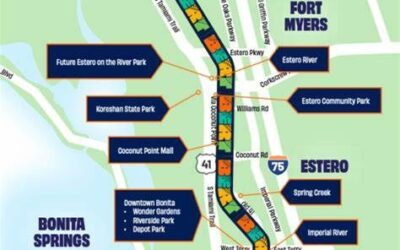
Bonita Estero Rail Trail: Momentum Builds Toward ConstructionThe Bonita Estero Rail Trail (BERT) continues to gain traction as our community edges closer to turning the former Seminole Gulf Railway corridor into a 14.9-mile recreational trail linking Bonita Springs...
Written by
Terry Flanagan
Vice President of Administration
Be Informed,
Get Engaged,
and Make an Impact!

At Engage Estero, we believe in the power of community. As a nonpartisan, nonpolitical, nonprofit, we conduct evidence-based research to provide unbiased information about local issues, helping you improve your quality of life.