


Understanding Florida Amendment 3: What Greater Estero Voters Need to Know About the Property Tax Proposal
Key Take-Aways
Engage Estero cannot advise residents on how to vote, but many Village of Estero and Lee County, Florida residents have asked for clarification on the 2026 Florida property-tax amendment.
1. How much property tax revenue is collected in Florida and Lee County? Florida collected $59.2 billion in property taxes statewide in 2025. At the local level in Southwest Florida, Lee County collected $2.19 billion in ad valorem property taxes.
2. What does the 2026 Florida property tax amendment do to homestead property values? The proposed constitutional amendment requires 60% voter approval to pass. It does not eliminate all property taxes immediately, but it exempts the first $250,000 of homestead value from non-school property taxes and directs the Florida Legislature to create a plan to phase them out.
3. How would lost local tax revenue be replaced in Lee County municipalities? The amendment does not specify a revenue replacement mechanism. Possible options include:
- Higher sales or other taxes
- Reduced local government spending
- New fees or state transfers
- A combination of these approaches
Florida state financial analysts estimate $45.8 billion in lost local revenue over five years from the portions already defined
4. How does the amendment impact the Village of Estero's local tax rate? If the amendment eventually eliminates non-school homestead property taxes, the Village of Estero will lose that revenue source, even though Estero’s tax rate is already very low. Whether the State of Florida replaces that money for local municipalities remains unknown
5. Why are Florida voters asked to vote without knowing the revenue replacement plan? The amendment asks Florida and Lee County voters to approve the overarching goal of reducing or eliminating certain property taxes. The specific details—how to fund Southwest Florida counties, cities, villages (such as Estero), and special districts afterward—are left to future Florida Legislatures.
Bottom Line for Estero & Lee County Voters: A “Yes” vote approves the Florida constitutional change but does not specify how the lost local revenue will be replaced. The financial plan would be decided later by the Florida Legislature. Lee County and Estero residents should confirm details with trusted official sources.
Published September 30, 2026 by Engage Estero
Written by

Allan Bowditch
President
Introduction
Engage Estero is a 501(c)(3) non-partisan organization. Because of our tax-exempt status, we are not permitted to advise residents on how to support political candidates or how to vote on specific ballot measures. However, many Estero residents we have spoken with recently regarding the property tax issue have expressed confusion about what they are voting on and what the local consequences would be if property taxes are significantly reduced or eliminated.
The following non-partisan analysis addresses the central questions surrounding Amendment 3 on the 2026 Florida ballot to help you make an informed decision.
The Questions Posed
Q 1. What was the total amount of property taxes collected in Florida and specifically in Lee County in 2025?
Answer: According to the Florida Department of Revenue’s 2025 County Profiles, Florida levied $59.169 billion in ad valorem (property) taxes in 2025. This total includes county, school, municipal, and other ad valorem taxes (Florida Dept. of Revenue).
For Lee County, the corresponding 2025 figures were:
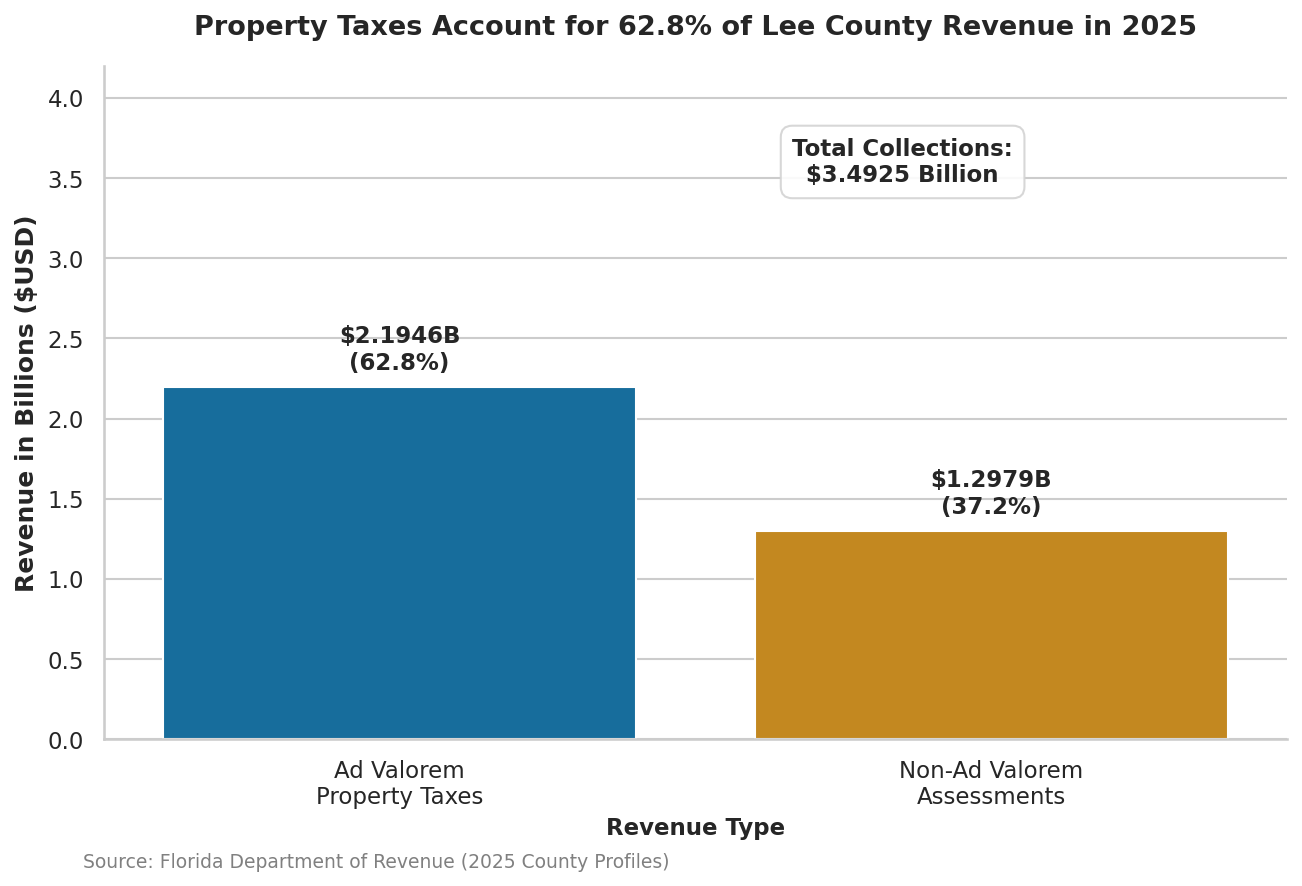
Total ad valorem property taxes: $2.1946 billion.
Total including non-ad valorem assessments: $3.4925 billion (Florida Dept. of Revenue).
- Ad Valorem taxes are calculated based on the property value.
- Non-Ad Valorem taxes are collected on the same bill, but are not based on the value of the property (e.g. stormwater, solid waste collection).
Q 2. What proportion of the vote in the upcoming election in Florida is required to eliminate property taxes?
Answer: Florida's Constitution generally requires proposed constitutional amendments to receive at least 60% approval. Abstaining from the amendment doesn't count as a “No”; the 60% is calculated based on the votes cast on that measure.
However, the current 2026 Florida ballot measure does not eliminate all property taxes immediately. The measure on the ballot, CS/HJR 1-F, would exempt the first $250,000 of homestead value from non-school property taxes and require the Legislature to establish a schedule to eliminate those taxes eventually. School-district property taxes remain outside that exemption.
Q3. Has any US state totally abolished the payment of Property Taxes?
Answer: As of 2026, no U.S. state has completely abolished property taxes statewide.
Q4. Has any “advanced” country abolished the payment of property Taxes?
Answer: All OECD countries levy some form of recurrent tax on immovable property. So, there isn't currently an OECD country that has completely eliminated recurring property taxation nationwide.
Q5. What are Florida property taxes used for?
Answer: Your property-tax bill generally pays for:
- Public schools
- County government — things such as sheriff/law enforcement, courts and corrections, roads, parks, libraries, emergency services, and other county functions.
- City government — if you live inside a municipality, a portion can go toward city services such as police, fire, roads, parks, and other municipal operations.
- Fire protection and emergency services
- Water management
- Mosquito control
School taxes are a major component of the bill.
Q 6. If over 60% vote to eliminate property taxes, how will this source of revenue be “found”?
Answer: So where could the replacement money come from? There are essentially four possibilities:
- Higher sales taxes or other state taxes.
Florida could shift some of the tax burden from property owners to consumption. Florida already has a state sales tax, along with locally imposed discretionary sales taxes, and the Legislature has statutory mechanisms to change those rates.
- Reduced local government spending.
If the lost property-tax revenue isn't replaced, counties, cities, and special districts would need to balance their budgets by cutting expenditures, using reserves, raising other fees, or a combination.
- A combination of the above.
This is probably the most important practical point: the Constitution doesn't magically create replacement revenue. The Legislature would have to decide how to restructure the tax system and/or spending.
Using the 2025 figures discussed above, Florida collected roughly $59.2 billion in ad valorem property taxes, though the proposed amendment doesn't eliminate that entire amount.
The proposed amendment itself acknowledges the revenue problem: its text directs the Legislature to establish a trust fund for grants to support implementation if the amendments are adopted (Florida Senate).
In Lee County, the question isn't simply “Will property taxes disappear?” It is: How much of the approximately $2.2 billion Lee County property-tax levy would disappear, how quickly, and what combination of sales taxes, state transfers, fees, and spending reductions would replace it?
Q 7: Who exactly does the “Legislature” mean when it says it would decide how to recoup the lost property tax revenue?
Answer: “The Legislature” means the Florida Legislature as a whole: the elected members of the Florida House of Representatives and the Florida Senate. It does not include the governor, the Department of Revenue, or county commissioners.
For the current 2026 property tax amendment, this distinction matters.
- Florida House: 120 elected representatives.
- Florida Senate: 40 elected senators.
Together, they enact the ordinary laws needed to implement the constitutional amendment.
How to Contact Your State Legislators
Florida State House of Representatives:
https://www.flhouse.gov/FindYourRepresentative
Florida State Senate:
https://www.flsenate.gov/Senators/Find
Q 8: Given that the Village of Estero has the lowest property tax rate in Florida, does that mean that the excellent way that local taxes have been handled would count for nothing if the vote to eliminate property taxes succeeds?
Answer: Yes. Although Estero has achieved a relatively low municipal property-tax rate through restrained spending and careful budgeting, eliminating the tax at the state constitutional level would remove the Village's ability to continue using that tax instrument.
A constitutional prohibition generally applies uniformly. If the amendment ultimately eliminates taxes on covered non-school homestead property, Estero couldn't simply maintain its existing property tax rate, despite its history of keeping it low. However, it might need to replace only a relatively small portion of its budget. A municipality that relies heavily on property taxes could face a much larger replacement requirement.
Q 9: Why is the public being asked to vote on eliminating property tax when they haven’t been told how the lost revenue will be obtained?
Answer: This question addresses the central policy issue. The ballot measure asks voters to approve a constitutional change while leaving much of the decision about the eventual replacement revenue to future legislatures. That is not unusual for a constitutional amendment, but it means voters are not voting on a fully specified “property tax replaced by X” package.
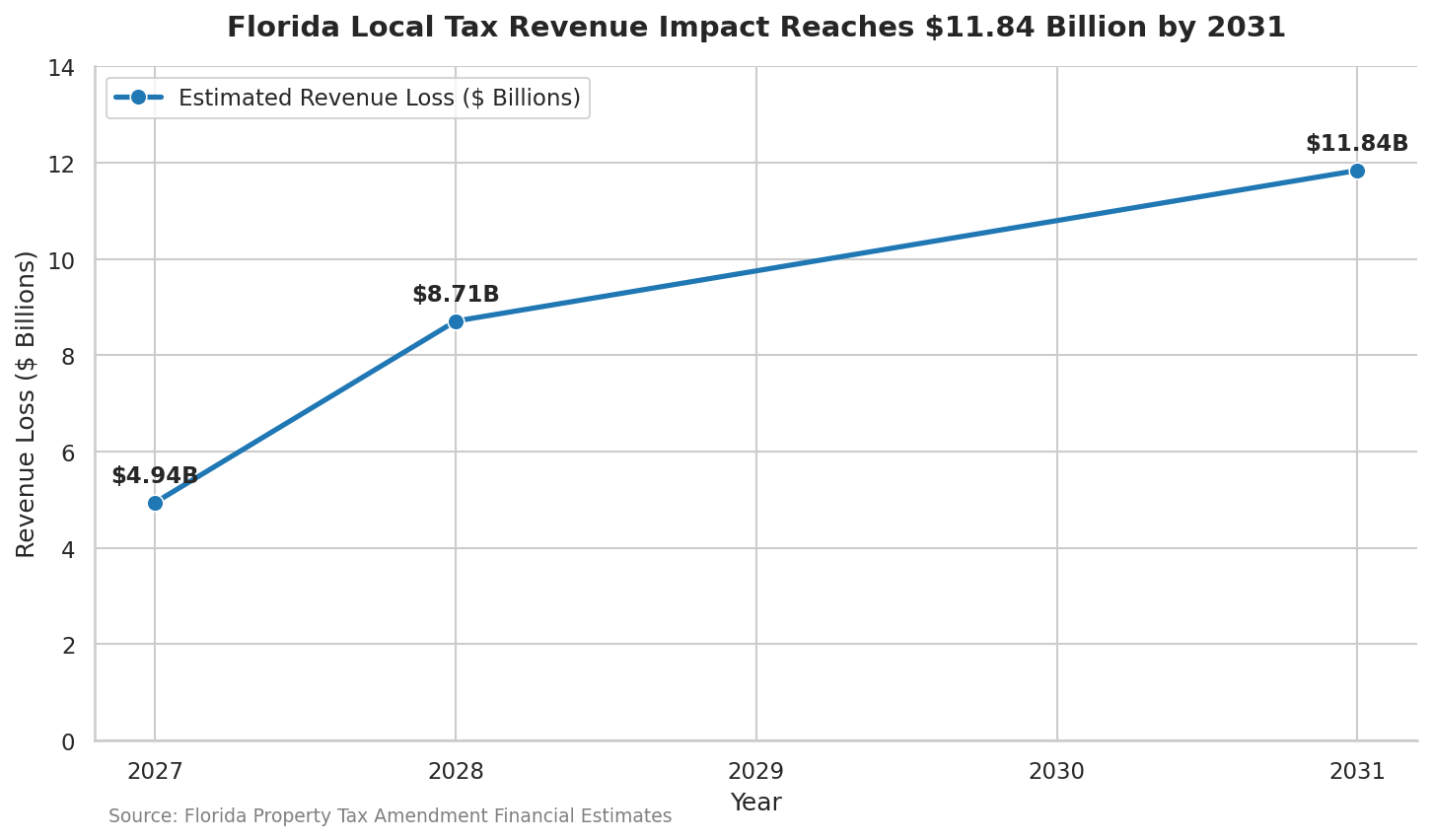
The state's Revenue Estimating Conference estimates that the portions currently specified in Amendment 3 would reduce local-government property-tax revenue by approximately $4.94 billion in 2027, $8.71 billion in 2028, and $11.84 billion by 2031—about $45.8 billion in total over those five years. These figures do not include the additional cost of eventually eliminating the remaining non-school homestead property taxes.
Q10. If Amendment 3 is passed and Property Taxes are eliminated does this result benefit low income and the disabled individuals?
Answer: Florida's Amendment 3 (2026) does not favor low-income individuals or disabled people as a whole, though low-income homeowners on fixed incomes would see direct property tax relief, although many do receive property tax concessions.
But the net impact is heavily debated, and many policy experts and advocacy groups argue that the measure could financially disadvantage low-income renters and individuals with disabilities who rely heavily on local public services.
In conclusion
In brief, we have a situation where, in practical terms, the sequence is:
- Voters: “Do you want the Constitution changed so that these property taxes are reduced/eliminated?”
- Florida House + Senate: “If voters approve it, how do we implement it and balance local-government finances?”
- Future legislation: Determine whether the lost money comes from state appropriations, other taxes, fees, spending reductions, or some combination.
That's a legitimate legislative structure, but it introduces uncertainty.
The Florida Senate has considered legislation that would have the state appropriate funds to offset property-tax losses for fiscally constrained counties. That legislation demonstrates one possible mechanism, but it isn't equivalent to a comprehensive statewide replacement plan.
The state's own revenue analysis also highlights an important point: Florida's property taxes are primarily local-government revenue, not state revenue. Consequently, replacing them isn't simply a matter of the state finding another $10–$12 billion in its existing budget. The money would have to come from somewhere to the counties, cities, villages, and special districts that currently depend on property taxes. (Ref. Florida TaxWatch+1)
That is especially relevant to the earlier question about Estero. If Estero has kept its municipal property-tax rate unusually low, it could still lose that revenue source under a statewide constitutional change. Whether the Legislature subsequently provides Estero with dollar-for-dollar replacement funding, or expects Estero to find the money elsewhere, is a separate decision.
How Should You Vote? The most precise answer to the questions being asked is:
The public is being asked to vote on the constitutional objective first, leaving the detailed fiscal mechanism to the Legislature. The ballot measure itself does not tell voters, “a 1% sales-tax increase will replace your lost property-tax revenue,” or any similarly specific alternative.
That distinction is important when evaluating what a “Yes” vote actually commits Florida to and what it leaves for future lawmakers to decide.
Engage Estero believes the information above is helpful and will clarify your decision on Amendment 3 on the November ballot. If you are interested in learning more about this issue, Professor Shelton Weeks recently wrote the article referenced below 1, which examined the underlying economics that will ultimately determine the effect of this amendment. Professor Weeks is a Lucas Professor of Real Estate and the director of the Lucas Institute for Real Estate Development & Finance at Florida Gulf Coast University’s Lutgert College of Business.
Reference:
- Florida property tax repeal comes with economic trade-offs. By Shelton Weeks, Sep 1, 2026; Updated Sep 8, 2026, Gulfshore Business. https://www.gulfshorebusiness.com/inside-the-magazine/florida-property-tax-repeal-would-shift-costs-to-other-taxes/article_0c924e79-0879-44ad-b010-c702e14b7faf.html
Related Articles
Good Things Happening in Estero: Key Updates on Local Parks, Taxes, Traffic Safety & Recreation
October 22, 2026


Be Informed,
Get Engaged,
and Make an Impact!

At Engage Estero, we believe in the power of community. As a nonpartisan, nonpolitical, nonprofit, we conduct evidence-based research to provide unbiased information about local issues, helping you improve your quality of life.