
Estero’s Economy Is Growing—But More Carefully
Key Take-Aways
- Measured Economic Expansion: Estero and Southwest Florida continue to expand, but local growth has shifted from a rapid post-pandemic surge to a more cautious, selective pace.
- Employment Resilience Led by Local Anchors: Regional employment added approximately 6,000 jobs year-over-year, driven primarily by education, healthcare, and professional services—directly benefiting Estero mainstays like Lee Health Coconut Point and FGCU.
- Selective Consumer & Visitor Spending: Regional taxable sales reflect tighter discretionary spending across SWFL, but tourism fundamentals remain solid with airport passenger activity (+2.7%) and tourist-tax revenue (+14.2%) trending upward.
- Housing Market Rebalancing: Single-family home transactions increased 6.1% as buyers and sellers realign, while regional single-family building permits dropped 15.6% as builders adjust to market demand.
- Energy Price Sensitivity: Estero’s automobile-dependent lifestyle and tourism-driven local market make regional discretionary spending highly sensitive to sustained spikes in fuel and oil prices.
Published September 15, 2026 by Engage Estero
Written by

Terry Flanagan
Vice President of Administration
 As Estero transitions from the quieter summer months into another busy season, the local economy is sending a mixed—but understandable—message: growth continues, but it is becoming more selective.
That distinction is important. An economy rarely moves in a single direction. Employment, consumer spending, tourism, housing, and construction can each tell a different story at the same time. The latest regional indicators suggest that Southwest Florida continues to expand, but at a more measured pace than during the extraordinary post-pandemic boom.
Employment Remains a Source of Strength
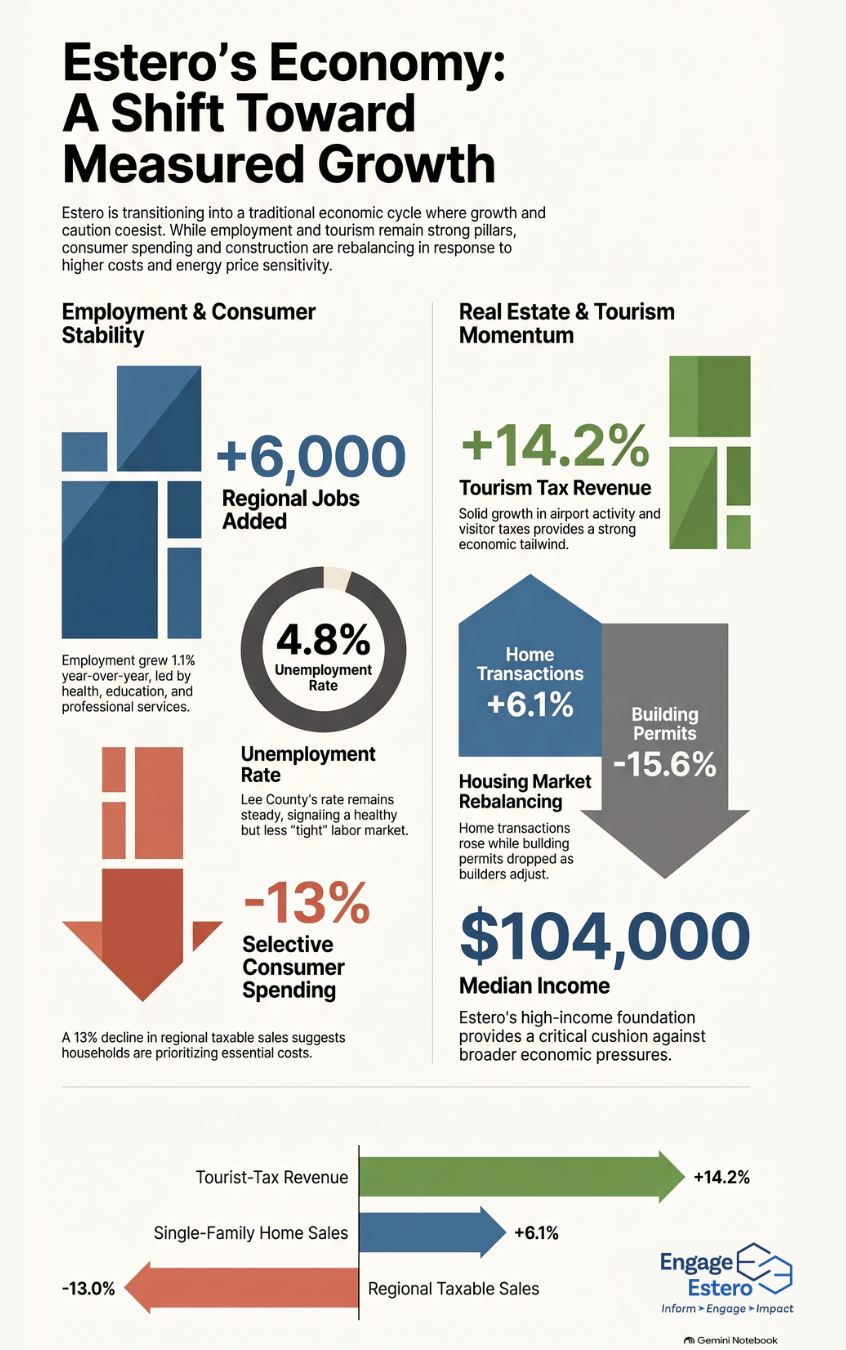
Employment is a good place to start. The three coastal counties of Southwest Florida had about 557,000 seasonally adjusted jobs in July, up about 6,000, or 1.1%, from a year earlier, according to Florida Gulf Coast University’s Regional Economic Research Institute. Education and health services recorded the largest increase, followed by leisure and hospitality and professional and business services.
Those gains are especially relevant to Estero. Healthcare, hospitality, education, and professional services are closely tied to our community through Lee Health Coconut Point, Florida Gulf Coast University, hotels, restaurants, retailers, and the many businesses serving our growing population.
At the same time, the labor market has become somewhat less tight.
Lee County’s seasonally adjusted unemployment rate was 4.8% in July, unchanged from June and 0.6 percentage points above the previous year. Across the broader Southwest Florida region, unemployment stood at 5.0%.
That does not signal a recession. Rather, it suggests that the supply of available workers may be growing faster than employment—or that workers are taking somewhat longer to find their next job.
For employers, this can offer some relief from the intense hiring pressures of recent years. For households, however, a softer labor market can prompt greater caution, particularly regarding major purchases.
Consumer activity offers another indication that the pace of growth is shifting.
FGCU’s regional indicators show that taxable sales declined 13% from March 2025 to March 2026. A single year-over-year comparison does not establish a long-term trend, and the figure reflects the broader Southwest Florida region rather than Estero specifically. Nevertheless, it remains a meaningful indicator for a community whose economy depends heavily on retail, restaurants, services, and other forms of discretionary spending.
The takeaway is not necessarily that consumers have stopped spending. Rather, they may be spending more selectively.
That distinction could become increasingly important as households contend with housing costs, insurance, energy prices, and other recurring expenses.
Tourism Continues to Provide a Tailwind
Tourism offers an encouraging sign.
Regional tourist-tax revenue increased by 14.2% from April 2025 to April 2026, while airport passenger activity rose by 2.7% from May 2025 to May 2026.
These figures indicate that Southwest Florida continues to attract visitors, even as consumers appear more thoughtful about how they allocate their dollars.
For Estero, tourism matters. Visitors and seasonal residents support hotels, restaurants, retail, entertainment, transportation, and a wide range of service businesses. A healthy tourism sector can therefore help offset some of the caution evident elsewhere in the economy.
Housing Is Finding a New Balance
The housing market is also showing signs of improvement.
Regional single-family home sales increased 6.1% year over year, though price performance varied considerably across the region’s counties.
An increase in transactions is generally a healthy development. More sales allow buyers and sellers to set prices through actual market activity rather than waiting for a market dominated by uncertainty.
At the same time, new construction appears to be responding cautiously to market conditions. Regional single-family building permits were down 15.6% from June 2025, suggesting that builders are closely monitoring demand, financing costs, inventory, and buyers' ability to absorb new-home prices.
In other words, the housing market is rebalancing.
Oil Prices Could Add Another Layer of Pressure
Energy prices are another factor worth watching closely.
Higher oil prices affect the economy well beyond the gas pump. Residents may first notice the impact through gasoline and airfares, but businesses can face higher costs for deliveries, service vehicles, transportation, packaging, and petroleum-based materials. Contractors may face higher transportation and supply costs, while restaurants and retailers may face higher costs to move products into Southwest Florida.
Eventually, some of those expenses are likely to be passed on to consumers.
Estero is particularly sensitive to energy costs because daily life depends heavily on automobiles, and tourism and seasonal residency rely on affordable road and air travel. When households spend more on fuel, transportation, and utilities, they have less left for restaurants, shopping, entertainment, and charitable giving.
That can put pressure on discretionary spending, on which many local businesses depend.
The duration of an oil-price increase matters more than any single day's price. A short-lived spike may have limited long-term consequences. By contrast, persistently elevated energy prices can contribute to inflation and raise operating costs for households, businesses, and public projects.
Because Southwest Florida is primarily an energy consumer rather than an oil-producing region, higher oil prices are more likely to translate locally into higher costs rather than higher income.
What Does This Mean for Estero?
The overall picture is one of continued growth accompanied by greater caution.
First, Estero's underlying advantages remain significant. The community benefits from a relatively high-income population, major healthcare and educational institutions, established shopping and hospitality destinations, and ongoing population growth. Census Bureau estimates place the median household income at more than $104,000, though that figure reflects the 2020–2024 period.
These fundamentals provide an important cushion. They help explain why Southwest Florida can experience slower consumer activity or a softer labor market without necessarily moving into a broad economic downturn.
But strong fundamentals do not make the community immune to broader economic pressures.
Higher costs, elevated interest rates, insurance expenses, energy prices, and a more cautious consumer can all influence how quickly households make major purchases and how aggressively businesses invest and hire.
The Bottom Line
Estero's economy is still growing, but the character of that growth is changing.
The post-pandemic period was marked by extraordinary increases in migration, housing demand, consumer spending, and tourism. Today's environment looks more like a return to a traditional economic cycle: employment is expanding, tourism remains strong, and housing transactions are improving, but consumers and businesses are becoming more selective.
Sustainable economic growth does not require every indicator to rise every month. What matters is whether the community's underlying fundamentals remain strong enough to absorb periods of slower growth and adjust to changing conditions.
For Estero and Southwest Florida, current evidence suggests the economy remains solid. Still, the next phase of growth will likely require greater discipline, more careful spending, and tighter cost control.
That is not a warning of economic weakness. It reminds us that growth and caution can, and often do, coexist.
Frequently Asked Questions
Q: Is Estero, Florida entering an economic recession?
A: No. While Lee County’s unemployment rate rose slightly to 4.8%, regional job growth continues to expand (up ~6,000 jobs year-over-year). The local economy is undergoing a healthy rebalancing and return to traditional growth cycles rather than a recession.
Q: How do healthcare and education impact Estero’s local economy?
A: Institutions like Lee Health Coconut Point and Florida Gulf Coast University (FGCU) provide steady, year-round employment that helps insulate Estero from seasonal slowdowns in tourism and retail spending.
Q: How do rising energy and gas prices affect Estero residents and businesses?
A: Estero relies heavily on personal vehicle transport and incoming road/air tourism. Elevated fuel costs reduce household budgets for local dining and shopping while increasing delivery and operational costs for local businesses.
Related Articles

What Development is Happening along East Corkscrew Road? Why it Matters.
July 16, 2026


Be Informed,
Get Engaged,
and Make an Impact!

At Engage Estero, we believe in the power of community. As a nonpartisan, nonpolitical, nonprofit, we conduct evidence-based research to provide unbiased information about local issues, helping you improve your quality of life.